Don't know who to call?
When you or someone you love feels unwell, it is not always obvious who to contact. This page is here to make that choice simple.
We work in health care every day, so we know the system. You should not have to. Below is a plain guide to when to call 999, when to use NHS 111, when a pharmacist can help, and when to contact Ashcroft Surgery.
Emergency Call 999 now if someone has any of these
These are signs of a life-threatening emergency. Do not wait, and do not ring the surgery first.
- Signs of a heart attack — chest pain, or pressure, heaviness, tightness or squeezing across the chest.
- Signs of a stroke — the face has dropped on one side, they cannot hold both arms up, or their speech is slurred or muddled.
- Severe difficulty breathing — gasping, choking, or not able to get words out.
- Choking on food or liquid right now.
- Heavy bleeding that will not stop.
- A serious injury after a bad accident, a fall from height, or an assault.
- A fit (seizure) that is not stopping, or a person who cannot be woken up.
- Sudden swelling of the lips, mouth, tongue or throat.
- Sudden confusion — they cannot say their own name, or are behaving very oddly.
- Someone has taken an overdose, swallowed something poisonous, or has tried to end their life.
Please do not drive yourself to hospital. Ask someone to drive you, or call 999 and ask for an ambulance. Take your medicines with you if you can.
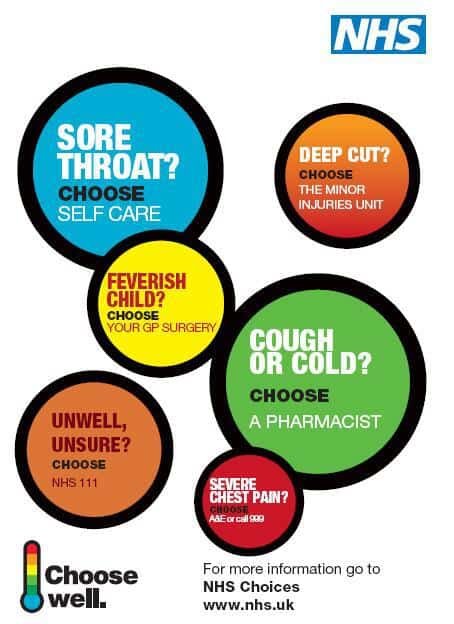
If you are not sure whether it is an emergency, that is completely normal. Ring NHS 111 and they will help you decide. It is always better to ask than to wait at home worrying.
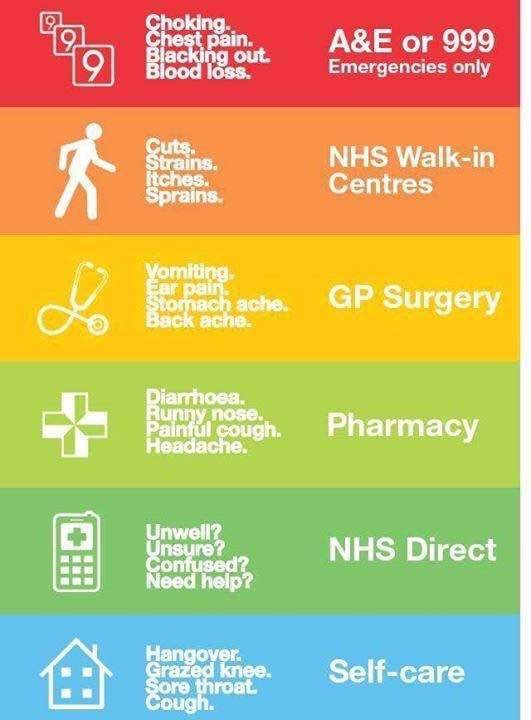
Six places to get help, from smallest problem to biggest
Think of it like a ladder. Most health worries are sorted on the bottom rungs. Only a small number need the top.
-
Look after yourself at home
Coughs, colds, sore throats, mild tummy upsets, small cuts and grazes. Rest, fluids and time.
Always available
-
Your pharmacy
Free NHS advice with no appointment. Pharmacists can now treat seven common illnesses, including sore throat, earache in children and urine infections in women.
Most are open evenings and weekends
-
Ashcroft Surgery
Longer-lasting problems, ongoing conditions, medication reviews, and anything that is worrying you and is not settling.
Monday to Friday, daytime
-
NHS 111
You need help now, it is not a 999 emergency, and you are not sure where to go. They will tell you what to do and can book you in somewhere.
24 hours, every day
-
Urgent Treatment Centre
Sprains, possible broken bones, cuts, burns and other urgent injuries or illnesses that are not life-threatening.
8am to midnight, every day
-
999 or A&E
Life-threatening emergencies only, such as a suspected heart attack or stroke, severe breathing problems or heavy bleeding.
24 hours, every day
Which service, and when
If you would rather see it all in one place, this table sums up the same advice.
| Where | Best for | When it is open | How to get it |
|---|---|---|---|
| Yourself, at home | Coughs, colds, sore throats, hangovers, mild sickness, small cuts, grazes and bruises | Always | Rest, fluids, paracetamol if suitable for you, and a well-stocked medicine cupboard |
| Your pharmacy | Minor illnesses, plus NHS treatment for seven common conditions. Advice on medicines. Emergency supply if you run out | Daytime, plus many evenings and weekends | Walk in and ask. No appointment needed |
| Ashcroft Surgery | Problems lasting more than a week or two, ongoing conditions, mental health, medication reviews, and anything that worries you | Monday to Friday, daytime | Phone 01274 612 279, or send a request through PATCHS |
| NHS 111 | Urgent help when the surgery is closed, or when you do not know where to go | 24 hours a day, every day of the year | Go to 111.nhs.uk, use the NHS App, or dial 111 |
| Urgent Treatment Centre | Sprains, suspected broken bones, cuts, minor burns, skin infections, high temperature, sickness and diarrhoea | 8am to midnight, every day including bank holidays | Contact NHS 111 first if you can. They may book you an arrival time |
| 999 or A&E | Life-threatening emergencies and serious injuries only | 24 hours a day, every day | Dial 999. Do not drive yourself to hospital |
Your pharmacist can do far more than you think
Pharmacists are qualified health professionals. They train for years in medicines and common illnesses. You do not need an appointment, and the advice is free.
Pharmacy First is an NHS service. It means a pharmacist can now assess you and, if it is right for you, give you prescription medicine for seven common conditions — without you seeing a GP first.
The seven conditions a pharmacist can treat
Each condition has an age range, because the treatment is only known to be safe and helpful within that range.
| Condition | Who it covers |
|---|---|
| Impetigo (a crusty skin infection) | Aged 1 and over |
| Infected insect bites | Aged 1 and over |
| Earache | Children aged 1 to 17 |
| Sore throat | Aged 5 and over |
| Sinusitis (blocked, painful sinuses) | Aged 12 and over |
| Urine infection (UTI) | Women aged 16 to 64 |
| Shingles | Aged 18 and over |
If you fall outside these age ranges, a pharmacist can still give you advice and suggest treatments you can buy. They will tell you if you need to see us instead.
Most pharmacies offer Pharmacy First, but not all. It is worth a quick phone call before you set off.
Other things pharmacies help with
- Coughs, colds, flu and sore throats
- Headaches, aches, sprains and strains
- Hay fever, allergies, dry skin and mild eczema
- Indigestion, constipation, diarrhoea and other tummy troubles
- Thrush, nappy rash, head lice and threadworms
- Emergency supply if you have run out of a regular medicine
- Blood pressure checks, contraception, and flu and COVID-19 vaccinations at many pharmacies
Good to know
- Most pharmacies have a private room. You do not have to explain your problem at the counter.
- The advice is free. If you are given a prescription medicine, the usual NHS prescription charge applies unless you are exempt.
- The pharmacist will update your GP record, so we know what has happened.
- If the pharmacist thinks you need a doctor, they will say so and help you get to the right place.
Read NHS advice on how pharmacies can help (opens in a new tab)
Watch: how your pharmacist can help
This short film explains what pharmacists can do and when to visit one. It plays from YouTube, so YouTube may set its own cookies when you press play.
You do not need to watch the video to understand this page. Everything it covers is written out in the sections above.
NHS 111 — the service to use when you don't know who to call
NHS 111 is free and open 24 hours a day, every single day of the year, including weekends and bank holidays.
Use NHS 111 if you
- need medical help quickly, but it is not a 999 emergency
- are unwell when the surgery is closed
- do not know which service you need
- think you might need A&E but are not certain
- need a repeat of a regular medicine urgently and cannot reach a pharmacy or the surgery
- have a dental problem and no dentist
How to contact NHS 111
- Online: go to 111.nhs.uk or use the NHS App. This is usually the quickest way and is for anyone aged 5 and over.
- By phone: dial 111. Use the phone for children under 5.
- Mental health: call 111 and choose the mental health option.
- Deaf or hard of hearing: call 18001 111 using text relay, or use the British Sign Language video service.
- Other languages: ask for an interpreter. It is free.
NHS 111 will ask you questions about your symptoms. They may give you advice, send you to a pharmacy, arrange a call back from a nurse or doctor, book you into an urgent treatment centre, or send an ambulance if you need one. They will not give you a diagnosis, but they will point you to the right place.
The Urgent Treatment Centre in Bradford
An Urgent Treatment Centre deals with many of the problems people go to A&E for. Waits are often shorter, and you do not need to be registered with a GP.
Where it is and when it is open
The Urgent Treatment Centre is next door to A&E at Bradford Royal Infirmary, Duckworth Lane, Bradford BD9 6RJ.
Book in at the A&E reception desk and staff will send you round to the Urgent Treatment Centre.
Open 8am to midnight, seven days a week, including bank holidays. When it is very busy it may stop taking new patients around 11pm.
The centre cannot give advice over the phone. Please do not ring to ask about waiting times.
What they can help with
- Sprains and strains
- Suspected broken bones
- Cuts, bruises and other injuries
- Stomach pain, vomiting and diarrhoea
- Skin infections and rashes
- High temperature in children and adults
- Mental health concerns
- Emergency contraception
If you need one, they can arrange an X-ray, blood tests or a heart tracing (ECG), and can give you a prescription.
Contact NHS 111 first if you can. They may be able to book you an arrival time, so the centre knows you are coming and you wait less.
The Urgent Treatment Centre does not look after wounds after an operation or change regular dressings. For that, please contact us at the surgery or the team who carried out your procedure.
Read NHS advice on when to go to an urgent treatment centre (opens in a new tab)
When to contact Ashcroft Surgery
We are the right place for problems that are not emergencies but do need a health professional to look at them properly.
Contact us for things like
- a symptom that has lasted more than a week or two and is not settling
- a long-term condition such as asthma, diabetes or high blood pressure
- your mental health
- medication questions, reviews and repeat prescriptions
- a lump, a mole, unexplained weight loss, or bleeding that worries you
- results, referrals and follow-up after hospital care
- anything that is frightening you, even if you cannot explain why
Same-day help for urgent problems
Every day, one of our clinicians is set aside to deal with urgent medical problems. This is for people who feel very unwell, or whose symptoms are getting worse rather than better.
Examples include:
- blood where there should not be blood — coughing it up, or in your urine or bowel motions
- a high temperature, especially in a child
- sudden or quickly worsening pain
- breathlessness that is new or distressing
- feeling drowsy, muddled or not yourself
- severe vomiting, diarrhoea or tummy pain
- a new headache that is unusual for you
We know it can be frustrating when the answer is "that is not urgent". We are not trying to turn you away. There are only so many same-day slots, and keeping them for the sickest people is how we make sure someone seriously ill can be seen today. If your problem is not urgent, we will still help — we will just book you into a routine appointment instead.
How to contact us
Our phone lines open at 8.30am. Between 8.30am and 10am, please ring only if you think you need to be seen or spoken to today, or you need a home visit. Please call after 10am for everything else — booking ahead, asking about results, or general questions. The lines are much quieter then and our team can give you more time.
You can also send us a request online at any time using PATCHS. You fill in a short form about your problem, and it goes to the person best placed to help. It might be a GP, a nurse, our in-house pharmacist, or a member of our admin team.
Please do not use PATCHS for an emergency. Online requests are not read straight away and are not checked overnight or at weekends. If you need help now, use NHS 111. If it is an emergency, call 999.
Why we ask what your problem is
Our reception team are trained to ask a little about why you are getting in touch. They are not being nosy, and they are not deciding whether you deserve an appointment.
They ask because there may be a quicker or better route for you. A sick note, a prescription query or a form may not need a doctor at all. A rash might be better seen by a nurse. A medication problem might be sorted the same day by our pharmacist. They can only offer you those options if they know what the problem is.
You do not have to give details if you would rather not, and you can always ask to speak somewhere more private. It just helps us get you to the right person faster.
Other people at the surgery who can help you
A GP is not always the fastest or the best person to see. Our team includes several health professionals you may not know about.
Practice pharmacist
An expert in medicines. Good for side effects, medication reviews, and questions about what you are taking and why.
Practice nurses
Long-term condition reviews, asthma and diabetes checks, cervical screening, immunisations, dressings and travel-related health advice where we provide it.
Healthcare assistants
Blood tests, blood pressure checks, heart tracings (ECGs), height and weight, wound checks and stitch removal.
Social prescriber or wellbeing worker
Practical help with the things that affect your health but are not medical — stress, loneliness, confidence, getting active, losing weight, stopping smoking, or finding local groups.
District nurses
Nursing care at home for people who cannot get to the surgery. Wounds, dressings, injections and support for people who are very unwell.
Health visitors and midwives
Health visitors support children from birth to 5 years. Midwives look after you through pregnancy and just after birth.
If you are not sure who you need, just tell us what the problem is and we will match you to the right person.
If you are struggling, or worried about someone
Mental health emergencies are emergencies. You do not need to have used mental health services before, and you do not need to be at your very worst before you ask for help.
Emergency If life is at risk
Call 999 or go to A&E now if someone has seriously harmed themselves, has taken an overdose, or is in immediate danger.
Urgent mental health support, day or night
- First Response — 0800 952 1181. Free, 24 hours a day, for people of all ages in Bradford, Airedale, Wharfedale and Craven.
- NHS 111 — dial 111 and choose the mental health option.
- Guide-Line (Bradford District and Craven Mind) — 0800 188 4884, open 8am to midnight every day, for a confidential talk. Not a crisis line, but they can refer you on.
Other places to turn
- Samaritans — 116 123, free, 24 hours a day, whatever you are going through.
- Shout — text SHOUT to 85258 for free, confidential support by text message.
- Night OWLS — 0800 148 8244, for children, young people, parents and carers, 8pm to 8am.
- Ashcroft Surgery — contact us in the usual way for support that is not urgent, including talking therapies and medication.
If you are not sure how urgent it is, please ring First Response or NHS 111. They would far rather hear from you early.
Teeth, eyes and other services you can go to directly
Some problems are better dealt with by someone other than a GP. Going straight to the right service usually means being seen sooner.
Teeth and gums
GPs cannot treat dental problems and cannot prescribe for them. Please contact a dentist.
Out of hours, your dental practice answerphone will usually tell you what to do. If you do not have a dentist, contact NHS 111 and they can put you in touch with an emergency dental service.
Go to A&E if you have a facial injury, severe swelling, heavy bleeding from the mouth, or you feel generally unwell with a dental infection.
Eyes
For a sudden eye problem — flashes, floaters, a change in vision, pain, redness or something in the eye — contact an optician first. Many opticians can see urgent eye problems quickly.
Please phone before you go, as this is usually not a walk-in service.
Call 999 or go to A&E for a serious eye injury, chemicals in the eye, or sudden loss of vision.
Sexual health and contraception
You can go directly to a sexual health service for testing, treatment and contraception, without a GP referral. Many pharmacies also provide emergency contraception and some ongoing contraception.
Talking therapies
You can refer yourself for NHS talking therapies for anxiety, low mood, stress and worry. You do not need to see a GP first.
What to do when the surgery is closed
Our phone lines are closed in the evenings, at weekends and on bank holidays. You are not left without help.
Minor problem
Try a pharmacy. Many are open into the evening and at weekends. NHS.uk will tell you which ones are open right now.
Urgent, but not an emergency
Use NHS 111 online or dial 111. They are open all day and all night, every day of the year, and can arrange for you to be seen if you need it.
Emergency
Call 999 or go to A&E. Do not wait for the surgery to open, and do not drive yourself.
A tip that saves a lot of stress: before a bank holiday weekend, check whether you have enough of your regular medicines. Order your repeat prescription in good time. If you do run out, NHS 111 online can arrange an emergency supply from a local pharmacy.
Trusted places to check your symptoms online
These NHS sites are free, reliable and kept up to date. They are a good first stop if you want to understand a symptom before deciding what to do.
NHS.uk Health A to Z
Clear information on hundreds of conditions, symptoms and treatments, including when to get help.
NHS 111 online
Answer questions about your symptoms and get told exactly what to do next, at any time of day or night.
The NHS App
Order repeat prescriptions, view parts of your record, check test results where available, and get help from NHS 111.
Questions people often ask us
I really am not sure how serious this is. What should I do?
Contact NHS 111. That is exactly what the service is for. Dial 111, or use 111.nhs.uk if the person is aged 5 or over. They will ask about the symptoms and tell you where to go.
If at any point someone stops breathing properly, cannot be woken, is bleeding heavily or you think they are having a heart attack or stroke, stop and call 999.
My child is unwell. Who should I call?
For a child under 5, please phone 111 rather than using the website. The online service is only designed for people aged 5 and over.
Call 999 straight away if your child is having a fit that is not stopping, cannot be woken, is choking, has a rash that does not fade when you press a glass against it, is struggling to breathe, or has heavy bleeding or a serious injury.
For milder illnesses, a pharmacist can help with earache in children aged 1 to 17 and sore throats from age 5. Contact us at the surgery if you are worried, or if your child is not getting better.
Is it quicker to go straight to A&E?
Usually not, unless it is a real emergency. Everyone arriving at A&E is assessed and the most seriously ill people are seen first, so someone with a less serious problem may wait a long time.
Contacting NHS 111 first often gets you seen faster, because they can send you to the right place and sometimes book you an arrival time.
I have run out of my regular medicine. Who do I call?
During surgery hours, contact us or your pharmacy. Please allow time for repeat prescriptions to be processed.
If we are closed and you cannot wait, NHS 111 online can send a request to a local pharmacy for a limited emergency supply, to tide you over until you can order your normal repeat.
Can I be seen at an Urgent Treatment Centre if I am not registered with a GP?
Yes. You do not need to be registered with a GP or have a fixed address to be seen at an Urgent Treatment Centre, and you do not need to know your NHS number.
If you would like to register with a GP, anyone living in England can register with a practice. Please get in touch with us and we will explain how.
Can I still get help if English is not my first language, or if I am Deaf?
Yes, and it is free. Ask for an interpreter when you contact any NHS service, including us, NHS 111, the Urgent Treatment Centre and A&E.
If you use British Sign Language, NHS 111 has a video relay service. If you use text relay, you can contact NHS 111 on 18001 111 at any time.
Please tell us at Ashcroft Surgery if you need an interpreter, so we can book one before your appointment.
What if I get it wrong and call the wrong service?
Then we will help you get to the right one. Nobody expects you to know the NHS inside out, and you will not be told off for asking.
The one thing we would ask is this: if something feels seriously wrong, do not sit at home worrying about whether you are bothering anyone. Ring 999 or NHS 111. It is always better to check.
Last reviewed: July 2026 · Next review due: July 2027
Accessibility options
Change how this page looks. Your choices are saved on this device for next time.